
The Machine That Predicts Your Next Thought
Notes on Chapter One of my forthcoming book, "Artificial Intelligence, NeuroData, and Society: Law at the Edge of Cognition"

An introduction to my book- AI, NeuroData and Society, Law at the Edge of Cognition - chapter by chapter with resources and video lectures too! What’s not to love?
There is a familiar story about artificial intelligence and power. It says that platforms know us because we click, search, scroll, buy, pause, linger, and return. They build models from the traces we leave behind. Those models are used to predict what we might do next. The law, in turn, seeks to determine whether the data was collected fairly, whether consent was meaningful, whether the prediction was discriminatory, and whether the final decision harmed a person.
That story is already too late.
The first chapter of *Artificial Intelligence, NeuroData, and Society* begins from a more uncomfortable premise: the next frontier is not merely behavioural prediction. It is cognitive inference. Systems trained on neurodata and on behavioural and biometric proxies calibrated against neurodata are beginning to operate upstream of action. They do not simply wait for a person to choose, speak, click, or decide. They learn from signals associated with hesitation, fatigue, emotional salience, attention, motivation, and pre-conscious orientation.
They seek to understand how choice forms before it becomes visible.
That shift matters because much of modern law still assumes that inner life remains practically inaccessible until the person expresses it. We protect speech, action, data, contract, consent, bodily integrity, and privacy because these are the forms in which persons become visible to institutions. But what happens when the relevant system does not need expression? What happens when a model can infer vulnerability, attraction, resistance, stress, or emerging intention before the person has named those states to themselves?
This is not a claim that machines now possess mystical access to the mind. The more serious problem is subtler. Prediction can acquire authority. A model need not be perfectly accurate to reshape the world around a person. It only needs to be trusted, operationalised, and connected to systems capable of acting on its inferences.
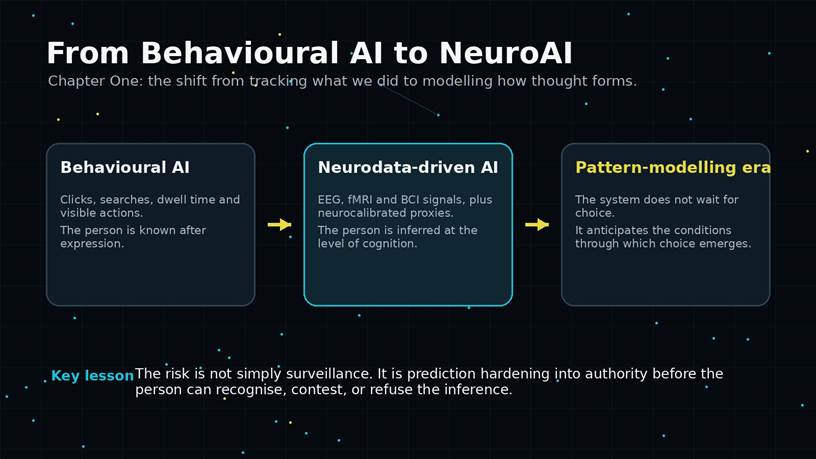
From behaviour to cognition
Earlier forms of digital profiling treated behaviour as the primary site of meaning. Search histories, clicks, purchases, dwell time, page views, likes, comments, and location trails enabled firms to infer preferences from expression. This produced enormous power, but it still depended on traces already externalised.
NeuroAI changes the point of attention. It describes systems that learn from neural signals or neurocalibrated proxies to model the conditions that precede behaviour. A headset may capture EEG patterns. An fMRI model may reconstruct aspects of visual or linguistic processing. A brain-computer interface may detect motor intention before physical action. A platform may use eye movements, reaction time, heart rate variability, cursor hesitation, or other proxy signals calibrated against neural patterns in controlled settings.
The risk does not depend entirely on direct brain access. This is essential. A legal framework that protects only raw neural recordings will miss much of the problem. Once neural ground truth has been used to train a model, ordinary signals can become cognitive proxies. The brain provides the calibration. The body supplies the scale.
Those questions are necessary. They are not sufficient.
Neuroprivacy must address inference, anticipation, and intervention. It is not merely the right to keep brain recordings secret. It is the condition under which mental states remain insulated from systematic computational modelling and manipulation. It asks whether systems should be permitted to turn cognitive signals into operative power over a person before the person can recognise or resist that power.
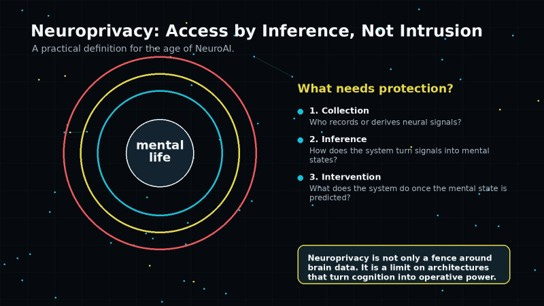
The central point is that access can occur without intrusion in the old sense. A system may not break into the mind. It may infer. It may aggregate. It may correlate. It may use ambient signals. It may act probabilistically. The result can still be a form of cognitive exposure. More importantly, it can be a form of cognitive control.
There is no discrete moment in which the individual can apprehend that cognition has become legible. That is precisely why notice-and-choice frameworks fail.
Neurodata is not simply biometric data with better branding
The answer is partly yes, but it doesn’t address the distinctive risk.
Biometric data usually identifies. A fingerprint, iris pattern, or facial template helps a system know who you are. Neurodata can do more than identify. It can support inferences about how cognition is forming. It can reveal mental states as dynamic, context-bound processes: attention, emotional orientation, fatigue, cognitive load, or emerging intention. Its significance lies less in classification than anticipation.
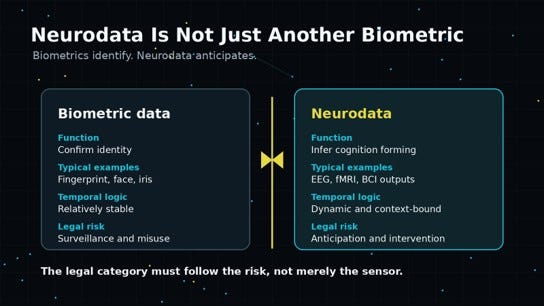
This is why legal treatment cannot rest only on whether neurodata uniquely identifies a person. That is the wrong question. The more important question is whether the data, or the model trained on it, enables systems to act on mental processes before conscious awareness.
A system that predicts a person is cognitively overloaded may change what they see. A system that infers susceptibility may time an offer. A workplace tool that reads fatigue may alter managerial decisions. A policing tool that claims to detect recognition or deception may reshape suspicion. In each case, the harm is not exhausted by privacy loss. It is the conversion of cognitive life into a field of optimisation.
The Malik problem: influence without command
The chapter later introduces Malik, standing in an electronics store, undecided and overwhelmed. He wears a lightweight AR headset that tracks gaze, gesture, movement, and neural signals. The system detects markers associated with cognitive load and susceptibility. The lighting softens. The audio recalibrates. A personalised offer appears. Malik experiences relief. The product feels right. Nothing pushes him. Nothing commands him. Nothing lies to him.
That is precisely the problem.
Many legal frameworks are built around visible pressure. Fraud, deception, coercion, undue influence, aggressive practices, unfair terms - these concepts generally assume that something identifiable happens. But NeuroAI influence may operate by recalibrating the environment around the person. It does not remove choice. It makes one path feel easier, more natural, more attractive, or more prudent at the moment hesitation is still forming.
The user remains formally free. The world has been arranged in advance.
This is where the distinction between assistance and control begins to collapse. The same system can present itself as helpful, adaptive, personalised, and responsive. It may genuinely reduce friction. It may improve accessibility. It may make human-computer interaction feel more natural. But under commercial incentives, the same capacity can be used to time persuasion, intensify engagement, or steer decisions before resistance takes shape.
The dual-use problem is not incidental. It is built into the technology. A system that helps a person communicate may also make cognition more legible to institutions. A system that reduces cognitive overload in one setting may support surveillance or performance management in another. A model trained for therapeutic calibration may create commercially valuable mappings of intention, attention, or emotion.
This is why the chapter resists narrow domain thinking. The question is not whether neurotechnology is good or bad. It is how the same inferential capacity travels across domains with different incentives, safeguards, and power relations.
The regulatory gap is structural.
Existing law provides fragments of protection. Data protection law may cover personal data, health data, or biometric information. Human rights law protects privacy, autonomy, dignity, and freedom of thought.
Consumer protection law addresses unfair or deceptive practices. AI regulation may classify some systems as high risk or prohibit certain forms of manipulation.
Yet these regimes often look downstream. They search for identifiable processing, visible outputs, demonstrable harm, or familiar categories of data. NeuroAI operates upstream. It acts through data, inference, timing, feedback, and environmental recalibration. Its most significant effects may be gradual, cumulative, and difficult to isolate.
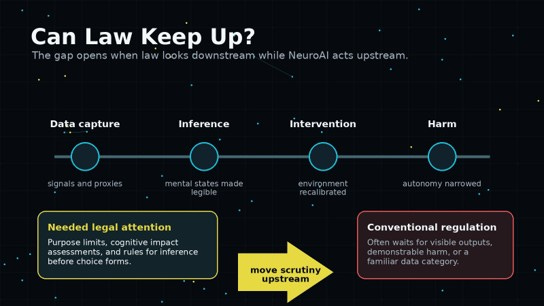
A law that waits for harm may arrive after cognitive agency has already been narrowed. A law that protects only neural data may miss neurocalibrated proxies. A law that relies on consent may fail where the user cannot understand the inferential architecture. A law that focuses on identification may miss anticipation. A law that regulates outputs may miss the process of output formation.
The chapter therefore asks law to move upstream. It is not enough to ask what a NeuroAI system decided. We must ask what data it was trained on, what cognitive states it inferred, what purposes those inferences served, and how the environment was changed before the individual could recognise the influence.
The Lesson of Chapter One
The phrase “the machine that predicts your next thought” is intentionally provocative, but the point is not to dramatise the technology. The point is to discipline the legal imagination. The most serious danger may not be a machine that reads a fully formed thought. It may be a system that learns enough about the conditions of thought to shape what feels like a choice.
That is why Chapter One begins the book where it does. Before turning to policing, courts, corporate manipulation, rights, or the AI Act, we need a vocabulary for the terrain. NeuroAI is not just another AI application. Neurodata is not just another biometric. Neuroprivacy is not just brain-data confidentiality. And autonomy is not protected merely because a person can still click, buy, refuse, or agree.
Freedom requires more than the formal availability of options. It requires conditions under which a person can recognise, deliberate, and resist. If systems operate before those conditions have stabilised, law has to ask whether the decisional gap itself deserves protection. That is the threshold at which the book begins.
The future of AI regulation is, increasingly, the governance of cognition. The question is whether law can see that clearly before cognitive inference becomes ordinary infrastructure.

Source: *Artificial Intelligence, NeuroData, and Society: Law at the Edge of Cognition*.
Now available to Pre-Order: https://www.bloomsbury.com/uk/artificial-intelligence-neurodata-and-society-9781509993628/
#NeuroAI, #ArtificialIntelligence, #Neurodata, #Neurotechnology, #Neurorights, #AIRegulation, #DataProtection, #PrivacyLaw, #FreedomOfThought, #CognitiveLiberty, #LawAndTechnology, #DigitalRights, #ConsumerProtection, #PlatformRegulation, #HumanRights